How to Plan a Walking Meeting That Stays Focused
A walking meeting can help a conversation stay focused without a conference table. Choose a workable route, pace, and format that fit the discussion.
How do you keep a walking meeting focused without making it feel like a conference room on the move? A walking meeting works best when the route, purpose, and note-taking plan are chosen for the conversation rather than treated as afterthoughts. It is a format for certain kinds of work, not a default for every meeting.
Walking meeting purpose
Start with the decision or question that needs attention. A walk can suit a planning discussion, a problem with more than one plausible answer, or a check-in that benefits from time to think. It is less useful when participants need to review detailed documents, share a screen, or reach a precise decision from a dense set of facts.
Write the purpose in one sentence before inviting anyone. For example: “Identify the next handoff between design and operations.” That gives the conversation a center without requiring a rigid script. If the purpose includes confidential information or a sensitive personnel issue, choose a private setting instead.
Route and logistics
Pick a familiar route that does not require constant navigation. A quiet park loop, a campus path, or a level sidewalk with places to stop can work. Check for busy crossings, construction, uneven surfaces, and places where traffic noise may interrupt conversation. If those conditions are hard to avoid, meet indoors or sit somewhere quiet.
Tell participants the planned route and whether the meeting will return to its starting point. Ask about access needs and offer a seated or remote alternative without asking anyone to explain personal details. A walking meeting should not make participation depend on keeping up, tolerating weather, or being comfortable outdoors.
Before setting out, decide what happens to phones and documents. If the conversation requires a shared file, review it beforehand and bring only the notes needed to guide discussion. Avoid reading or typing while moving; stop in a safe place if you need to check information.
Meeting preparation
Keep the preparation practical:
- Check the purpose: if it can be stated as one clear question, use it to open the meeting; if not, narrow the discussion or keep it seated.
- Check the route: if it is quiet, familiar, and accessible to everyone attending, use it; if not, choose another path or an indoor setting.
- Check the topic: if it can be discussed in public, proceed; if it involves confidential details, move to a private room.
- Check the materials: if no one needs to read or mark up a document while walking, leave it for later; if detailed review is required, meet around a table.
- Check the pace: if everyone is comfortable, continue at that pace; if someone is straining to keep up, slow down, stop, or switch formats.
- Check the outcome: if a decision or task emerges, pause to record it; if the conversation remains exploratory, name what still needs consideration before ending.
Keeping discussion focused
Open by stating the purpose and asking what each person needs from the conversation. Keep the first question narrow enough to answer, then let related points surface as they become relevant. If the talk wanders, return to the question without treating every detour as wasted time.
Do not try to capture detailed minutes from memory while moving. One person can note a few keywords on a phone after stopping, or the group can return to a desk and write down decisions together. Confirm who owns each follow-up and what remains unresolved.
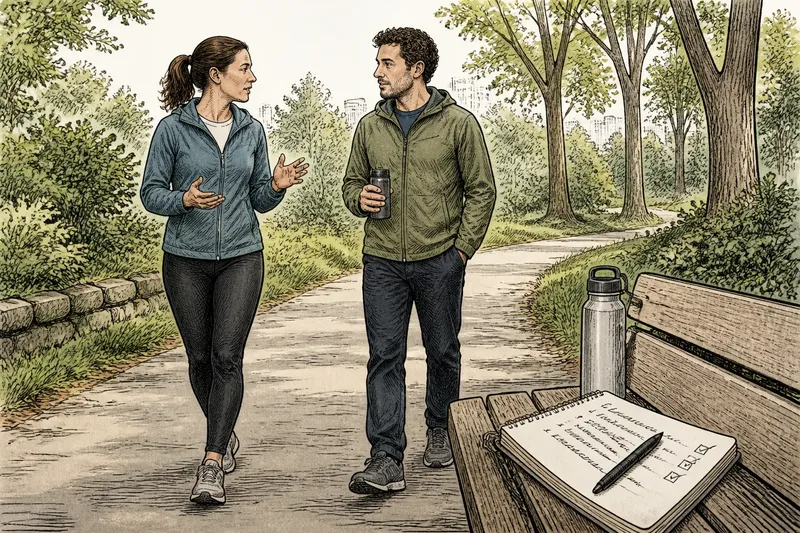
Say you and a coworker have a handoff to clarify. The invented starting point is that each of you has a different understanding of what information must accompany a project. You choose a familiar, level path, agree to discuss only the handoff, and stop at a bench to record the agreed items. The resulting answer is a shared list of what the next person needs; if you still disagree, you note the open question and schedule a private desk meeting rather than forcing a conclusion on the route.
Walking meeting questions?
How long should a walking meeting be?
Set a clear end point based on the question and the route, rather than extending the meeting to fill the available time. If the discussion needs more work, record the remaining issue and decide whether another format would serve it better.
Should participants take notes?
Keep notes brief while moving, and stop before typing or reading. For detailed records, capture the outcome after the walk and confirm the wording with the people involved.
What if the weather changes?
Agree on a backup before meeting, such as a quiet room or a seated conversation. If conditions make the route uncomfortable or unsafe, use that alternative instead of pressing on.
Can a walking meeting include a group?
A small group may be able to talk comfortably if everyone can hear and contribute. If people split into separate conversations or cannot hear one another, stop, regroup, or move to a setting designed for group discussion.
When to choose another format
A walking meeting is not worth the effort if arranging the route becomes harder than having the conversation, or if the topic demands close reading, privacy, or steady visual attention. There is no need to add special gear, seek a scenic destination, or turn an ordinary check-in into an outdoor event.
Use a walking meeting when movement and a simple route support the task, and choose another format when they get in its way. The best walking meeting leaves participants with a clearer question, a recorded decision, or an honest account of what still needs attention.