The Myth of the Perfectly Balanced Week
A balanced week need not divide work, rest, and company evenly. Learn to spot what your schedule is crowding out and make a concrete, workable adjustment.
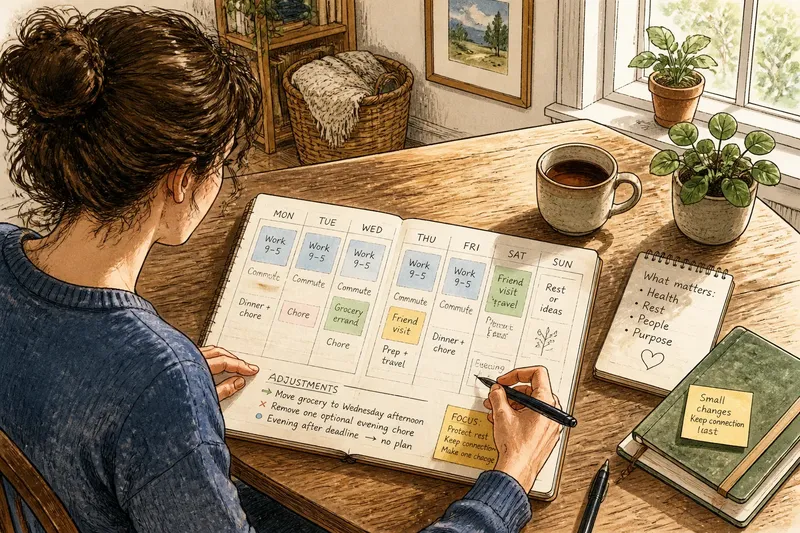
How do you make a balanced week when a deadline, a family duty, and your own need to rest all land at once? A balanced week is not a calendar with equal shares for work, recovery, movement, and company. It is a week whose shape reflects what is happening and leaves enough room for the needs that keep getting pushed aside.
A tidy schedule can hide a poor fit. A week may look full and purposeful while leaving no quiet transition between work and sleep, or it may look open because a difficult task has been put off. Instead of judging the calendar by how orderly it appears, ask what it makes easier and what it keeps postponing.
Map the week’s pressure
Before changing your routine, mark the commitments that are genuinely fixed: a shift, a school pickup, a medical appointment, or a deadline with consequences. Then mark the less visible demands around them, such as travel time, meal preparation, or the decompression you need after a difficult conversation. These are not empty spaces simply because they lack calendar entries.
Next, look for the point where pressure collects. Perhaps every evening has a task after work, or a caregiving duty leaves no pause before bed. The useful question is not how to make each day equally full. It is where one adjustment could prevent the same strain from repeating.
Choose a small adjustment
Try a simple review on paper or in a notes app. For each observation, decide what to keep, move, simplify, or ask someone to share. The alternatives matter: if a commitment cannot move, reducing its surrounding demands may be more realistic than trying to create free time from nowhere.
- Check whether a fixed appointment has travel or preparation time missing; if it does, add that time and move a flexible task, otherwise leave the schedule as it is.
- Check whether evenings contain a task every night; if they do, move one optional task to an open period or drop it, otherwise keep the current rhythm.
- Check whether a basic need such as meals or sleep is repeatedly squeezed; if it is, protect a simple meal or a calmer bedtime transition, otherwise avoid adding a new routine just for appearance.
- Check whether movement has become another demanding appointment; if it has, choose an ordinary walk or a stretch break instead, otherwise keep the activity that already fits.
- Check whether meaningful contact has been postponed more than once; if it has, suggest a brief call or shared meal, otherwise let the current plans stand.
- Check whether a care task could be shared or simplified; if it can, ask a specific person for a specific task or use an easier option, otherwise identify what support may be available from a trusted person or service.
What is not worth the effort is assigning every hour a score or color merely to make the week look balanced. A paper calendar can help reveal a collision; it cannot decide which need matters most to you.
Fit the plan to circumstances
During a demanding stretch
When work or caregiving intensifies, name what is temporary and what can actually be postponed. Keep essential commitments, reduce optional ones, and preserve a modest transition into rest where possible. If the pressure has no clear end, treat that as a sign to revisit the support or workload rather than accepting strain as the permanent schedule.
When energy is low
Make the plan smaller before adding habits. Choose a necessary task and one straightforward source of comfort, such as an easy meal or a quiet pause. If low energy persists or disrupts ordinary life, talk with a qualified health professional; scheduling alone may not address the cause.
When time opens up
Leave some of the space open. Use a portion for something you have missed, such as time outdoors or a visit, but do not turn every blank into a self-improvement assignment. A quiet afternoon can be useful without producing anything.
What does balance mean?
Does balance require equal time?
No. Workload, health, caregiving, and personal needs change from week to week. Look for a workable place for essential needs, not matching blocks on a calendar.
What if work takes over temporarily?
A deadline can make one week uneven. Note what is being squeezed out and decide what can be restored, simplified, or supported when the deadline passes.
How can I tell a pattern needs attention?
Notice recurring signs, such as having no unscheduled pause or repeatedly postponing contact that matters to you. Choose one adjustment aimed at that pattern rather than rebuilding the entire routine.
Should every day be planned?
Plan fixed commitments and the few tasks that truly need attention, then leave some room for changes. A schedule with no slack can make an ordinary disruption harder to absorb.
Work through one week
Imagine your hypothetical starting point is a week with a work deadline, a planned visit from a friend, a grocery errand, and evenings already occupied by small chores. First, mark the deadline and visit as fixed, then include the travel and preparation time for each. Next, move the grocery errand to an open afternoon and remove one optional evening chore. Finally, leave the evening after the deadline without a new plan. The resulting decision is a tradeoff: work and friendship stay, the errand shifts, and one chore waits so there is a clearer transition into rest.
A balanced week is less about getting every category onto every day than noticing which demand has become the default. Use “balanced week” as a prompt to inspect that pattern, not as a verdict on your discipline. If the same need keeps disappearing, make the next change specific—and small enough to survive the week you actually have.